

While the concept of a permanent establishment plays a key role in international tax law when determining where business profits are taxed, a foreign subsidiary is a separate legal entity and therefore does not constitute a permanent establishment of its parent company. Nevertheless, even where no permanent establishment exists for tax purposes, important tax issues arise within a corporate group, particularly with regard to the distribution of profits.
A typical example is the case where a Spanish subsidiary distributes dividends to its German parent company. This raises the following question: Is Spanish withholding tax payable on the dividend distribution? If so, under which conditions can it be avoided?
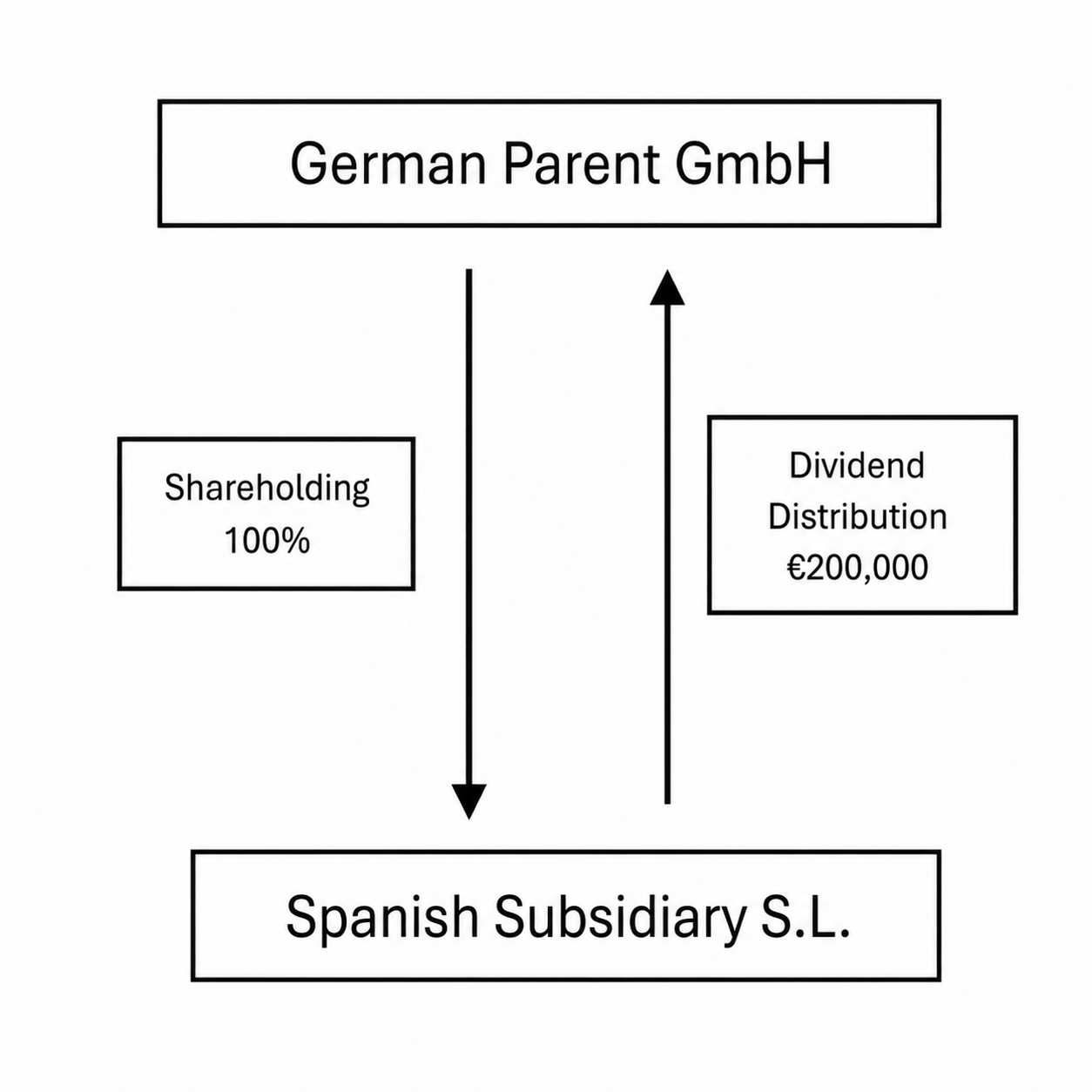
The answer is provided by Article 21 of the Spanish Corporate Income Tax Act (Ley del Impuesto sobre Sociedades – LIS). The corresponding German provisions for the reverse situation are Section 8b (1) of the German Corporate Income Tax Act (KStG) in conjunction with Sections 43b and 50d (3) of the German Income Tax Act (EStG).
The purpose of Article 21 LIS is to prevent economic double taxation within a corporate group by avoiding multiple taxation of the same profits at different ownership levels. Under certain conditions, a Spanish company may distribute dividends free of withholding tax even where the recipient is established abroad, for example in Germany.

Requirements for the Dividend Exemption under Article 21 LIS
1. Minimum shareholding of 5%: The recipient company must hold at least 5% of the share capital of the distributing company.
2. Minimum holding period of one year: The participation must have been held continuously for at least twelve months or be maintained until the one-year holding period has been completed.
3. Comparable taxation in the recipient's country of residence: The recipient company must be subject to a corporate tax regime comparable to the Spanish Corporate Income Tax. In the case of a German company, this requirement is fulfilled because Germany is not regarded as a tax haven and applies a comparable corporate tax system with a nominal tax rate of at least 10%.
4. Genuine economic activity: The corporate structure must not be abusive. In particular, the German parent company must not merely be a holding company without economic substance but must carry out genuine business activities. This requirement reflects the anti-abuse provision contained in Section 50d (3) of the German Income Tax Act (EStG).
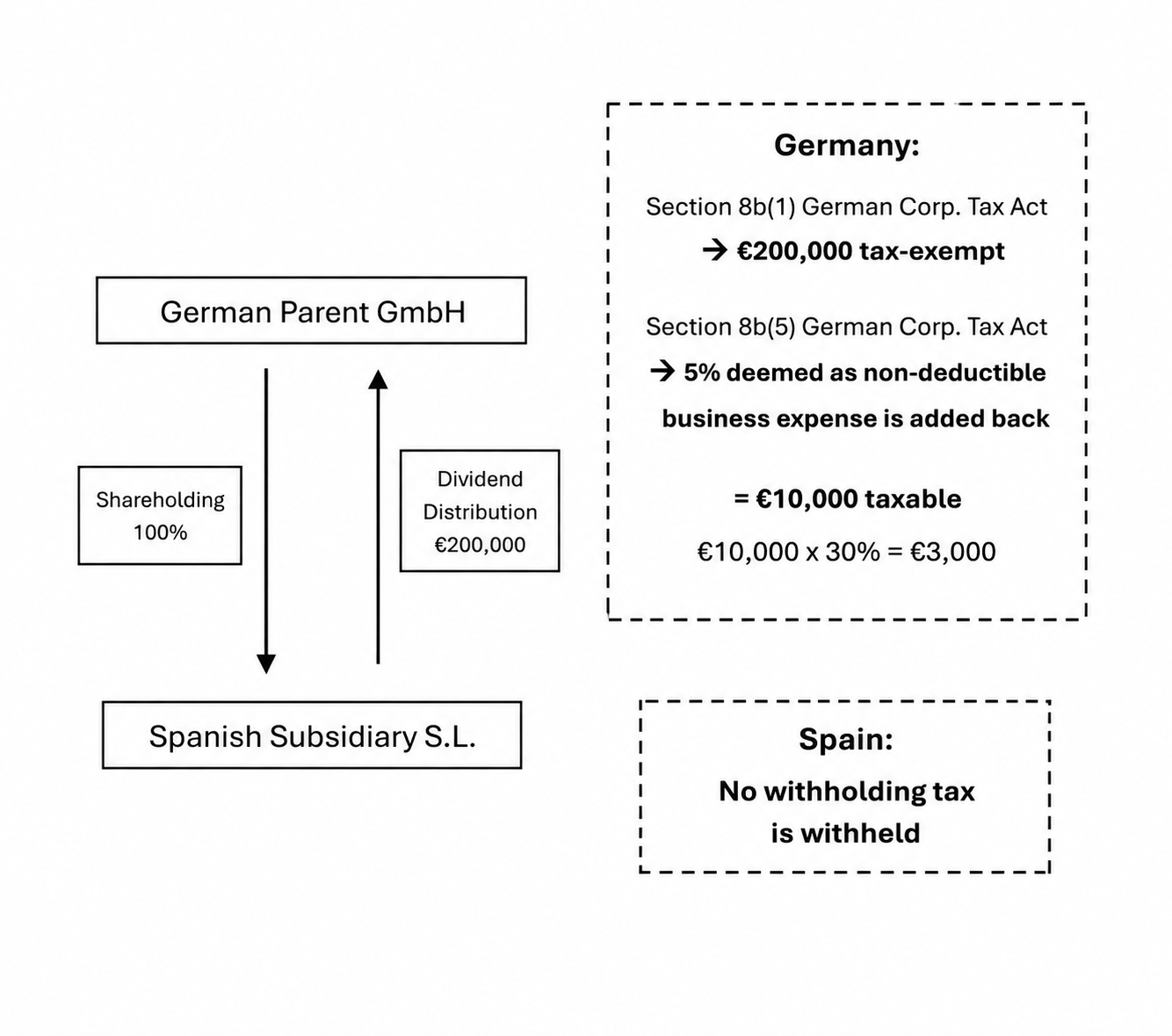
Article 14.1(h) of the Spanish Non-Resident Income Tax Act (IRNR) expressly refers to Article 21 LIS and confirms that dividends paid to non-resident companies—such as the German parent company in this example—are likewise exempt from Spanish withholding tax where the requirements of Article 21 LIS are met. Although Article 10(2)(a) of the Double Tax Treaty between Spain and Germany generally provides for a 5% withholding tax, this withholding tax is eliminated entirely if the conditions of Article 21 LIS are satisfied.
: 
Tax Treatment in Germany
At the level of the German parent company, Section 8b of the German Corporate Income Tax Act (KStG) applies. Under this provision, dividends received from shareholdings of at least 10% are generally exempt from corporate income tax. However, 5% of the gross dividend is deemed to constitute a non-deductible business expense pursuant to Section 8b (1) in conjunction with Section 8b (5) KStG. This amount is therefore added back to the company's taxable income.
As a result, the effective tax burden at the level of the German parent company is approximately 1.5% of the dividend received, provided that no abusive tax avoidance arrangement exists. Since no Spanish withholding tax is levied where the requirements of Article 21 LIS are fulfilled, there is no foreign withholding tax available for credit in Germany.
For example, where the gross dividend amounts to €200,000, only €10,000 (representing 5% of the dividend) will be subject to German Corporate Income Tax and, where applicable, German Trade Tax.
Assuming a Corporate Income Tax rate of 15% together with German Trade Tax (approximately another 15%, depending on the municipality), the combined effective tax burden amounts to approximately €3,000. This corresponds to an effective tax rate of approximately 1.5% of the original dividend (€3,000 on a dividend of €200,000).
Our law and tax firm will be pleased to analyse your individual situation, carry out the necessary administrative procedures on your behalf and prepare and file the relevant tax returns. If you have any questions or require legal or tax advice regarding this topic, please do not hesitate to contact us by email or telephone.
Author:

Rike Füllgraf
Tax Advisor
info@sspartners.es
Tel: (+34) 951 12 13 06
Facebook I LinkedIn I Amazon
Stay informed! Follow us on:


 (+34)
(+34)